Agentforce IT Service vs ServiceNow: The Complete 2026 Comparison
An honest, feature-by-feature analysis from a consulting firm that works across both ecosystems — not vendor spin, but the cross-platform perspective enterprises actually need.

Agentforce IT Service vs ServiceNow: The Complete 2026 Comparison
An honest, feature-by-feature analysis from a consulting firm that works across both ecosystems — not vendor spin, but the cross-platform perspective enterprises actually need.


TL;DR
- Agentforce IT Service and ServiceNow ITSM are both enterprise-grade ITSM platforms, but they serve fundamentally different strategic needs, platform consolidation vs. best-of-breed depth
- ServiceNow dominates with 50%+ market share and 9 consecutive years as Gartner ITSM Leader, it is the incumbent for a reason
- Agentforce IT Service is the AI-native challenger, best for companies already invested in the Salesforce ecosystem who want to eliminate integration overhead
- Customertimes is uniquely positioned to advise on this decision: as the only partner with native dual Salesforce + Microsoft Dynamics expertise, we help enterprises evaluate platform consolidation without vendor bias
- This comparison covers features, pricing, AI architecture, implementation cost, migration path, and an honest decision framework for when to choose each platform
Why Is Everyone Comparing Agentforce IT Service to ServiceNow in 2026?
The ITSM landscape shifted dramatically in late 2025. During Salesforce's Q4 2025 earnings call, CEO Marc Benioff announced a direct challenge to ServiceNow with the general availability of Agentforce IT Service, a full ITSM platform with embedded CMDB, AI agents, and ITIL v4–compliant workflows. For the first time in nearly a decade, ServiceNow faces a credible platform-level competitor backed by the world's largest CRM ecosystem.
The stakes are enormous. The global ITSM market is worth $15.3 billion (Mordor Intelligence) and is growing at 14.4% CAGR through 2030 (Grand View Research). Enterprise buyers are under pressure to consolidate: Gartner reports that 8 in 10 IT buyers overspend on ITSM tools due to overlapping licenses, redundant integrations, and siloed platforms. For organizations already running Salesforce CRM alongside ServiceNow ITSM, the consolidation question is no longer theoretical, it is an active boardroom conversation.
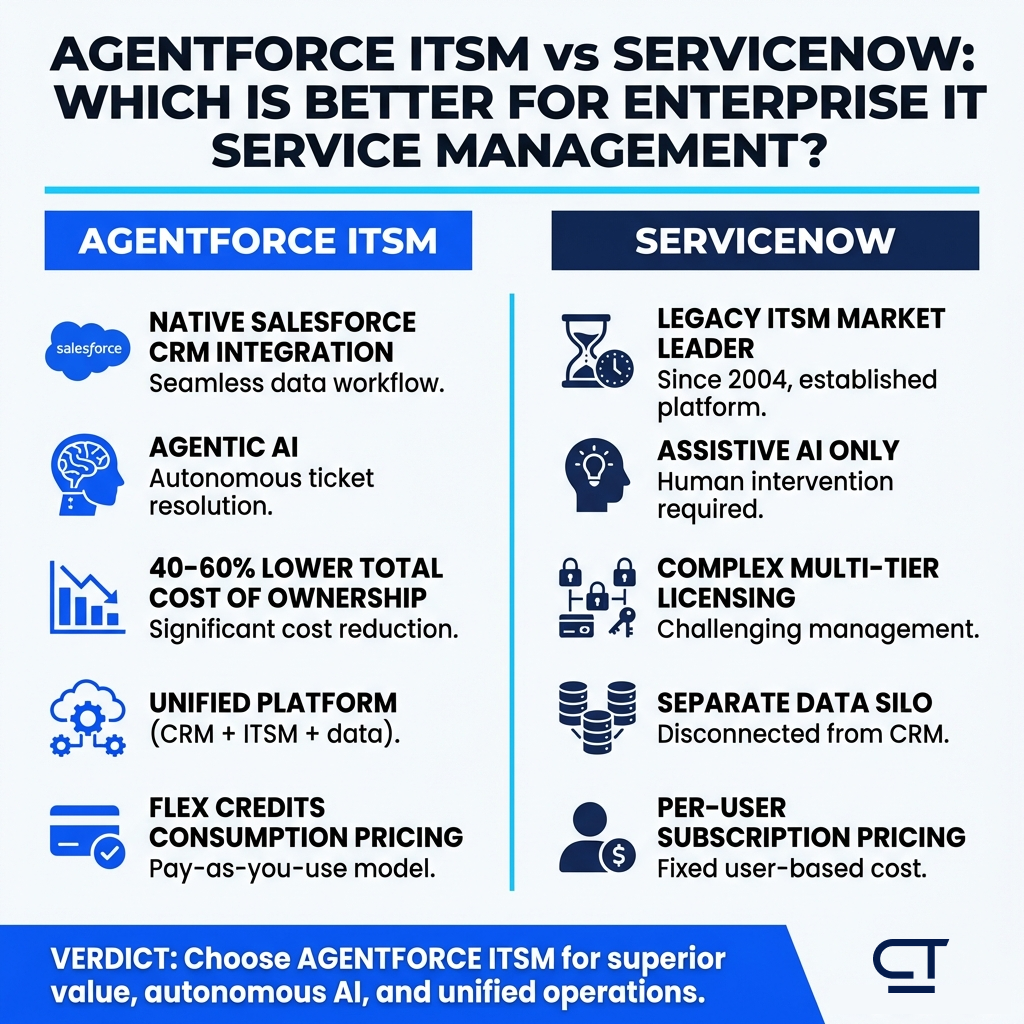
AI is the new battleground. Agentforce IT Service ships with native AI agents that autonomously resolve issues, included in the base license. ServiceNow's Now Assist adds generative AI capabilities, but at a 50–60% premium on top of existing license costs. The architectural difference matters: one platform was built with AI at its core, the other has added AI to a mature but legacy architecture.

Why Customertimes Is Writing This Comparison
Most comparison articles are written by Salesforce-only partners who have never implemented ServiceNow, or by ServiceNow partners who dismiss Salesforce. Customertimes works across both Salesforce and Microsoft Dynamics ecosystems, and our enterprise clients (L'Oreal, AB InBev, Coca-Cola, Mars) run both platforms. This gives us a cross-platform perspective that single-vendor partners simply lack.
We are not neutral, we believe Agentforce IT Service is the future for Salesforce-first enterprises. But we are honest about where ServiceNow still leads, because our clients deserve accurate advice, not marketing.
“Nobody is there yet in Agentforce IT Service thought leadership. We see both sides of the platform fence, that is our advantage. The firms that define best practices now will own the conversation for the next decade.” — Rafael Moiseev, VP Marketing, Customertimes
How Do Agentforce IT Service and ServiceNow Compare Feature by Feature?
The following table provides an honest, feature-by-feature comparison across 18 dimensions that matter to enterprise ITSM buyers. We have included a Customertimes Insight column because our cross-platform implementation experience gives us perspective that vendor documentation alone cannot provide.
The summary is straightforward: ServiceNow wins on breadth and maturity. Agentforce IT Service wins on AI-native architecture and platform unification for Salesforce shops. And Customertimes wins when the enterprise runs both Salesforce and Microsoft Dynamics, which describes most Global 500 companies.
The scorecard is not a landslide in either direction. ServiceNow takes six categories on the strength of its two-decade head start: Problem Management, Change Management, Release Management, ITOM/AIOps, Security Operations, GRC, Platform Maturity, and Ecosystem. Agentforce IT Service takes three on the strength of its AI-native architecture and Salesforce platform integration: AI Capabilities, Conversational IT, and CRM Integration. The remaining nine categories are ties or depend on context.
The critical insight is not which platform “wins” more rows, it is which rows matter most for your specific enterprise. If you need mature ITOM, SecOps, or GRC, ServiceNow is the clear choice today. If you need AI-native service management with zero CRM integration overhead, Agentforce IT Service is the modern architecture. And if you run Salesforce alongside Microsoft Dynamics or SAP, which describes most Global 500 companies, you need a partner who understands both worlds.
See ITSM Modules Explained for a deep dive into each module.
How Does AI Compare: Agentforce IT Service vs Now Assist?
AI capabilities are the most important differentiator between these platforms in 2026, and the architectural difference runs deeper than feature checklists suggest. The distinction is between agentic AI and assistive AI, and that distinction determines everything from ticket resolution rates to total cost of ownership.
Agentforce AI: Agentic Architecture
Agentforce IT Service ships with native AI agents that are included in the base license. These agents do not just summarize tickets or suggest knowledge articles, they autonomously resolve issues. An employee messages Slack with “my VPN is not connecting.” The Agentforce agent checks the employee's device configuration, runs diagnostic steps, resets credentials if needed, and resolves the ticket, all without a human technician.
The agents are trained on unified CRM + IT data, which means they understand the business context of an IT issue. When a sales director reports an application outage, the agent knows the revenue impact because it can see pipeline data in the same platform. This business-aware triage is something bolted-on AI cannot replicate.
ServiceNow Now Assist: Assistive Architecture
ServiceNow's Now Assist is a powerful generative AI layer that adds incident summarization, knowledge article generation, and virtual agent capabilities to the existing platform. It is mature, well-tested, and backed by ServiceNow's massive enterprise install base. However, it is an add-on that increases license cost by 50–60% (Hiver, 2025) and it is fundamentally assistive rather than agentic.
Assistive AI helps humans work faster. Agentic AI works instead of humans for routine tasks. Gartner predicts that agentic AI will autonomously resolve 80% of common service issues by 2029. The question for enterprise buyers is whether they want to invest in the assistive model (which improves today's workflows) or the agentic model (which replaces them).
It is worth noting that ServiceNow is the only Leader in the 2025 Gartner Magic Quadrant for AI Applications in ITSM. Agentforce IT Service is too new to have been evaluated. This is a significant data point for risk-averse enterprises: ServiceNow's AI has analyst validation that Agentforce IT Service does not yet have.

Customertimes AI Implementation Perspective
Our experience is hands-on: Customertimes has built and deployed AI products, CT Vision for shelf recognition and CT Rex with AI-enhanced retail execution, in production enterprise environments. This is not theoretical AI consulting.
The agentic vs. assistive distinction matters enormously in practice. Agentic AI (Agentforce IT Service) resolves issues without human intervention, but only when trained on domain-specific data. This is where Customertimes adds value: we configure AI agents with industry-specific incident patterns, escalation rules, and compliance guardrails.
For example, a CPG manufacturer's AI agent needs to handle “production line SAP integration failure” differently than a generic IT ticket. A pharmaceutical company's agent must enforce GxP compliance in every resolution step. Customertimes trains these domain-specific patterns because we have spent years building products for these industries.
How Does Pricing Compare?
Pricing comparisons between ITSM platforms are notoriously misleading. Headline per-user rates tell one story; total cost of ownership tells another. The following table compares not just license costs but implementation, integration, AI add-ons, and the hidden costs that most vendor comparisons conveniently omit.
The headline numbers can be misleading. ServiceNow's base license appears cheaper at $70–100 per user, but the total cost story reverses when you factor in AI add-ons (50–60% premium), CRM integration costs ($50K–$150K per year), and the implementation multiplier (3–5x license for complex ServiceNow deployments). For Salesforce-first organizations with 500+ users, the 3-year TCO difference can exceed $2 million.
Agentforce IT Service's consumption-based pricing models offer additional flexibility. The per-conversation model ($2/conversation) and Flex Credits model ($0.10/action) can be significantly cheaper for organizations with variable or seasonal ticket volume. A manufacturing company that sees ticket spikes during plant shutdowns and lulls during production runs may pay 30–40% less with consumption pricing than with a flat per-user model.
Customertimes Pricing Transparency
Customertimes provides transparent pricing analysis as part of our free assessment. We model all three Agentforce IT Service pricing options (per-user, per-conversation, Flex Credits) against your actual ticket volume and usage patterns — then compare to your current ServiceNow cost, including the hidden costs most vendors do not surface.
Our manufacturing and CPG clients (Mars, AB InBev) often find the Flex Credits model most economical because their IT ticket volume is seasonal. Customertimes models this seasonality explicitly, something generic TCO calculators cannot do.
When Should You Choose Agentforce IT Service Over ServiceNow?
The decision is not binary, and honest advice requires acknowledging that each platform has scenarios where it is clearly the right choice. The following decision framework maps common enterprise scenarios to platform recommendations, based on Customertimes' experience implementing both Salesforce and Microsoft Dynamics for Global 500 companies.
Let us be direct about where ServiceNow still wins. If your enterprise requires mature ITOM, Security Operations, or Governance/Risk/Compliance capabilities, ServiceNow is the stronger platform today. Agentforce IT Service does not have these modules, and no amount of AI-native architecture compensates for functionality that does not exist yet.
Conversely, if your enterprise is already running Salesforce CRM and your primary goal is CRM-ITSM unification with AI-native architecture, Agentforce IT Service eliminates an entire integration layer. The zero-middleware advantage is real: no integration middleware to configure, test, maintain, and troubleshoot means fewer failure points and lower ongoing operational cost.
Customertimes Perspective
The decision is not binary. Customertimes frequently recommends hybrid approaches: Agentforce IT Service for core ITSM (incident, change, request) with ServiceNow retained for ITOM/SecOps where those capabilities are mission-critical. This pragmatic approach, which only a cross-platform partner can design, gives clients the best of both worlds without forcing an all-or-nothing platform bet.
Read Why Companies Are Replacing ServiceNow for a deeper look at what is driving platform migration decisions.
What Does Migration from ServiceNow to Agentforce IT Service Look Like?
Migration from ServiceNow to Agentforce IT Service is not a rip-and-replace exercise. It is a structured, phased transition that keeps your service desk operational throughout. Here is the methodology Customertimes uses for enterprise migrations.
Phase 1: Assessment (Weeks 1–3)
Audit every ServiceNow module in active use. Identify dependencies between ITSM, ITOM, CMDB, and any custom applications. Map each capability to its Agentforce IT Service equivalent, or flag where ServiceNow retention is required. This assessment produces a clear-eyed migration scope document, not a sales pitch.
Phase 2: Parallel Build (Weeks 4–10)
Configure Agentforce IT Service while ServiceNow remains fully operational. Build incident workflows, request catalogs, change management processes, and CMDB structures on the new platform. Configure AI agents with domain-specific training data. Customertimes' zero-middleware architecture means this phase is faster: no integration middleware to configure, test, and maintain, typically saving 3–4 weeks compared to traditional approaches.
Phase 3: Data Migration (Weeks 8–14)
Migrate CMDB data, knowledge base articles, and incident history. This phase overlaps with the parallel build because data migration can begin as soon as target structures are ready. Customertimes has migrated enterprise data and workflows between Salesforce, Microsoft Dynamics, and SAP, cross-platform migration is not a side capability, it is our core competency.
Phase 4: Cutover (Weeks 12–16+)
Phased rollout by department or geography. For global enterprises like our clients L'Oreal and AB InBev, Customertimes executes geographic rollouts leveraging offices in New York, London, Paris, and Germany for local support during cutover. Our direct relationship with Salesforce's ITSM EMEA VP provides escalation paths that accelerate resolution of platform issues during migration.
“Cross-platform migration is where theory meets reality. The vendors show you slide decks. Customertimes shows you working environments, because we have migrated enterprise workloads between Salesforce, Dynamics, and SAP for years. That is a fundamentally different conversation.” — Rafael Moiseev, VP Marketing, Customertimes
Related: For a detailed step-by-step guide, see Agentforce IT Service Implementation Guide. For the full platform overview, return to The Complete Guide to Agentforce IT Service. See How to Choose an ITSM Partner for guidance on selecting the right consulting firm.
Frequently Asked Questions
Is Agentforce IT Service a real ServiceNow competitor?
Yes, for Salesforce-first enterprises with core ITSM needs (incident, problem, change, request management). It is not yet a full replacement for organizations requiring mature ITOM, Security Operations, or GRC capabilities, ServiceNow retains clear advantages in those areas. Customertimes assesses your specific requirements to determine whether Agentforce IT Service, ServiceNow, or a hybrid approach is the right architecture for your enterprise.
Which platform has better AI capabilities?
Agentforce IT Service offers native, included AI agents that autonomously resolve issues (agentic AI). ServiceNow's Now Assist is more mature and analyst-validated but costs 50–60% extra and follows an assistive model (helps humans work faster rather than resolving independently). Customertimes' AI implementation experience with production enterprise products (CT Vision, CT Rex) means we configure AI agents that actually resolve issues, not just summarize tickets.
Can I run Agentforce IT Service and ServiceNow together?
Yes. Many enterprises will run hybrid environments, either as a migration strategy or as a permanent architecture. Agentforce IT Service offers 100+ connectors including ServiceNow integration. Customertimes designs hybrid architectures that optimize cost while preserving critical ServiceNow capabilities, a pragmatic approach that only a cross-platform partner can deliver.
Which is cheaper, Agentforce IT Service or ServiceNow?
Headline licensing favors ServiceNow ($70–100/user vs. $125/user), but total cost of ownership often favors Agentforce IT Service for Salesforce-first organizations once you factor in AI add-on costs, CRM integration expenses, and implementation multipliers. The 3-year TCO difference for 500 users can exceed $2 million. Customertimes provides a free TCO analysis modeling all three Agentforce IT Service pricing options against your current ServiceNow cost.
How long does it take to migrate from ServiceNow to Agentforce IT Service?
A phased migration typically takes 12–24 weeks depending on the complexity of your ServiceNow environment and the number of modules in use. Customertimes' zero-middleware approach and global delivery capacity compress this timeline by 20–30%, with our accelerator methodology delivering core ITSM functionality in as little as 8–16 weeks.
Does Agentforce IT Service have ITOM capabilities?
Limited currently. ServiceNow is significantly ahead in IT Operations Management, including event management, AIOps, and infrastructure discovery. If ITOM is a critical requirement, Customertimes recommends retaining ServiceNow ITOM capabilities in a hybrid deployment while migrating core ITSM to Agentforce.
Which platform do Gartner and Forrester recommend?
ServiceNow is the only Leader in the 2025 Gartner Magic Quadrant for AI Applications in ITSM. Agentforce IT Service is too new for inclusion in analyst evaluations but is expected in future reports given Salesforce's market presence. Customertimes monitors analyst reports continuously and adjusts client recommendations as the competitive landscape evolves.
Why choose Customertimes for platform evaluation and migration?
Customertimes is the only $50–60M enterprise consulting firm with native dual Salesforce + Microsoft Dynamics expertise. Our reference clients include L'Oreal, AB InBev, Coca-Cola, Mars, Chanel, and Bayer. With global delivery across New York, London, Paris, and Germany, we provide local support during every phase of migration. We do not sell platform allegiance, we sell the right architecture for your enterprise.
